It starts with a sponsor’s meeting. Fans get a front-row seat to hear drivers field questions about the season ahead. It’s a nice touch. It’s not the most important gathering of the day, though. That honor belongs to the driver’s meeting.
Held two hours before the green flag drops, this session is where NASCAR officials lay out rule changes. Teams need to know the fine print. A missed detail can cost a race.
Then comes the walkout. Thirty minutes to go. Drivers hit the track, waving to the crowd. They slide into their cockpits. It isn’t a quick seatbelt click. Safety protocols are rigorous. Specialized equipment must be secured. Every buckle, every harness, every layer of fire-resistant gear is checked. You can dig deeper into the specifics in our guide on How NASCAR Safety Works.
Finally, the moment arrives.
“Gentlemen, start your engines.”
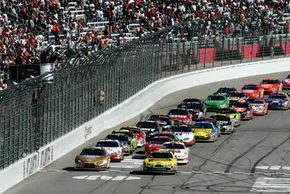
The roar is visceral. Forty-three cars wake up. All NASCAR races use a flying start. The cars are already moving when the race officially begins. They follow the pace car at roughly 70 mph. The pace car pulls off. The green flag waves.
Chaos ensues.
Critics claim NASCAR lacks skill. They say it’s just driving in circles. They’re wrong. A typical race demands heavy strategy. It requires immense driver skill. Much of this strategy hinges on the track itself.
Understanding Track Grooves and Passing Mechanics
Every track has “grooves.” These are the lines where tires get the best grip. Some tracks offer one groove. Others offer two—a low groove and a high groove.
This distinction changes everything.
On a one-groove track, passing is a nightmare. To overtake, you must leave the grip of the groove. You drive on a part of the track that makes the car harder to handle. You slide. You lose time. You lose momentum.
Two-groove tracks are different. They provide another “sweet spot.” Passing becomes easier. You can switch lanes. You can use the high line or the low line to gain an advantage.
Either way, overtaking remains one of the sport’s most challenging maneuvers.
Good drivers know how to block. They move their cars side-to-side. They create a wall. This makes passing on straightaways particularly difficult. A lead driver can glance in the rearview mirror. They can see the threat coming. They can adjust their line.
But the turns? That’s where the game changes.
Drivers must keep their eyes forward during a turn. They cannot look behind them. They are vulnerable. This represents a prime opportunity for a trailing driver to sneak around.
Watch closely. Many drivers will ride right on the bumper of the car in front. They wait. They bide their time. They let the leader exhaust their tires. And then, in the blink of an eye, they dart past.
It’s not just circles. It’s chess at 200 miles per hour.
The checkered flag hasn’t waved yet. The strategy is still unfolding. The track is still changing. And somewhere out there, someone is waiting for that one gap in the armor.