


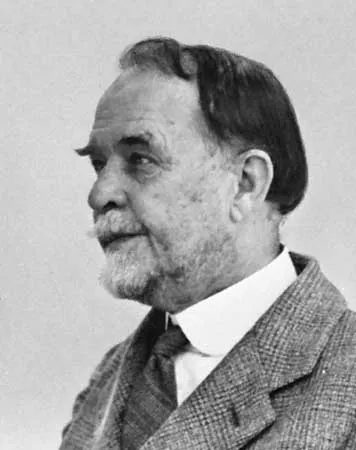
Thomas Hunt Morgan did not set out to discover genetics. He’s a zoologist from Lexington, Kentucky, who spent his early career understanding how eggs become animals. By the time he died in Pasadena in 1945, he had won the Nobel Prize and fundamentally changed our understanding of heredity. But the journey there is chaotic. He resisted the idea of making himself famous.
Morgan grew up in a family with deep ties to American history. His father, Charlton Hunt Morgan, served as the US Consul. His uncle, John Hunt Morgan, was a Confederate general. Young Thomas went his own way. He studied animal science at Kentucky State University (now the University of Kentucky) and then graduated from Johns Hopkins University. There he studied under the famous morphologist William Keith Brooks. Morgan received his Ph.D. In 1890 he spent a year at Hopkins and then accepted a teaching position at Bryn Mawr College, where he met his wife, Lillian Sampson, an accomplished cytologist.
Challenging Darwin and Mendel
Between 1893 and 1910, Morgan focused on embryology. He wanted to understand the cause and effect of development. He dissected early embryonic cells. He tested how salinity affected fertilized and unfertilized eggs. He studied how the physical orientation of an egg determines its future shape. This is definitely experimental science.
Despite his empirical approach, however, Morgan was skeptical of the dominant theory of evolution at the time. He considered that Darwin’s theory of natural selection was incomplete. A clear mechanism for the inheritance of characteristics is missing. Darwin proposed “pangenesis” as a hypothesis, but it did not stand up to scrutiny. Evolution seems to be a fact, but the “how” remains unclear.
Morgan’s objections deepened. He studied the emerging Mendelian and chromosome theories and recognized echoes of the old and worthless idea of ”pre-formation”. This 18th-century idea held that inside a sperm or egg cell was a tiny, fully formed adult body waiting to develop. To Morgan, the idea of separate “units” with specific properties, or chromosomes, feels like a return to an outdated way of thinking. Although he acknowledged that chromosomes might play a role, he argued in 1895 and later in 1909-1910 that no single chromosome could be responsible for a particular hereditary trait.
He considered Mendelian genetics purely hypothetical. Of course, we can also predict reproductive outcomes. But the process is not explained. He was not convinced by the fact that chromosomes separate during cell division in a way that reflected Mendel’s mathematical proportions. Coincidence, he thought. It is not a cause and effect relationship.
The fly that changes everything
It was at Columbia University that everything shifted. In 1904, Morgan married Lillian Sampson and accepted a professorship in experimental zoology at Columbia University. He stayed there for 24 years. In the Fly Room at Columbia University, he began testing his suspicions with the fruit fly Drosophila melanogaster.
The choice of organisms is realistic. Fruit flies reproduce quickly. They are cheap to maintain. They produce thousands of offspring. But there are also risks. Morgan remains outside the mainstream of genetics. He needed a proof that was more than just math.
He started looking for mutations. Natural variations. He looked for deviations from the norms that would be passed down from generation to generation. In 1910 he found one. Male flies have white eyes instead of the usual red eyes.
It’s not just a color change. It was a clue. When Morgan bred a white-eyed male and a red-eyed female, all of the first generation had red eyes. This property appears to have disappeared. However, in the second generation, the white eyes returned. Surprisingly, most white-eyed flies are male.
Morgan realized this was no accident. Eye color characteristics are related to gender. If genes are just abstract elements floating around in the cytoplasm, why would they segregate with male gender? This pattern is consistent with the behavior of the X chromosome. Females have two X chromosomes. Men have X and Y. The white eye mutation occurs on the X chromosome.
This is a simple but elegant explanation. It worked. Morgan found the first physical evidence that genes are located on specific chromosomes. He moved genetics from abstract probability to concrete biology.
Connection points
Morgan didn’t stop at one gene. He’s looking for more. He found variations in wing shape, body color and bristle size. He mapped them. He discovered that genes located close to each other on the same chromosome tend to be inherited together. They are “connected”. Genes that are far apart on the same chromosome are more likely to separate during cell division, called crossover.
This allowed Morgan and his students to create the first genetic map. Based on the frequency of genetic recombination, the relative location of genes on chromosomes can be determined. It’s like creating a city map by measuring how often you take detours during a road trip.
The theory of chromosomal inheritance is no longer a hypothesis. This is a model that works. Morgan showed that chromosomes are physical carriers of genetic information. He showed that genes are arranged linearly along chromosomes. Each gene controls a specific, identifiable trait.
This is a big change. Before Morgan, genetics was a black box. We can use math to predict the outcome, but we don’t know the mechanism. Morgan gave heredity a body.
Why is it important?
Morgan’s research laid the foundation for modern genetics. This shows that biological traits are more than just a vague effect of environment and chance. These are physical structures that are encoded and passed down from generation to generation. Thanks to this understanding, today we can track diseases, understand evolutionary relationships, and even edit genes.
But Morgan’s road was not easy. He was an ardent experimenter who initially rejected the theory but eventually accepted it. He asked for physical evidence. He refused to accept statistical correlation as causation. His skepticism and refusal to accept a theory that was “too neat” without evidence led him to investigate it.
Fruit flies were once considered pests, but they are today
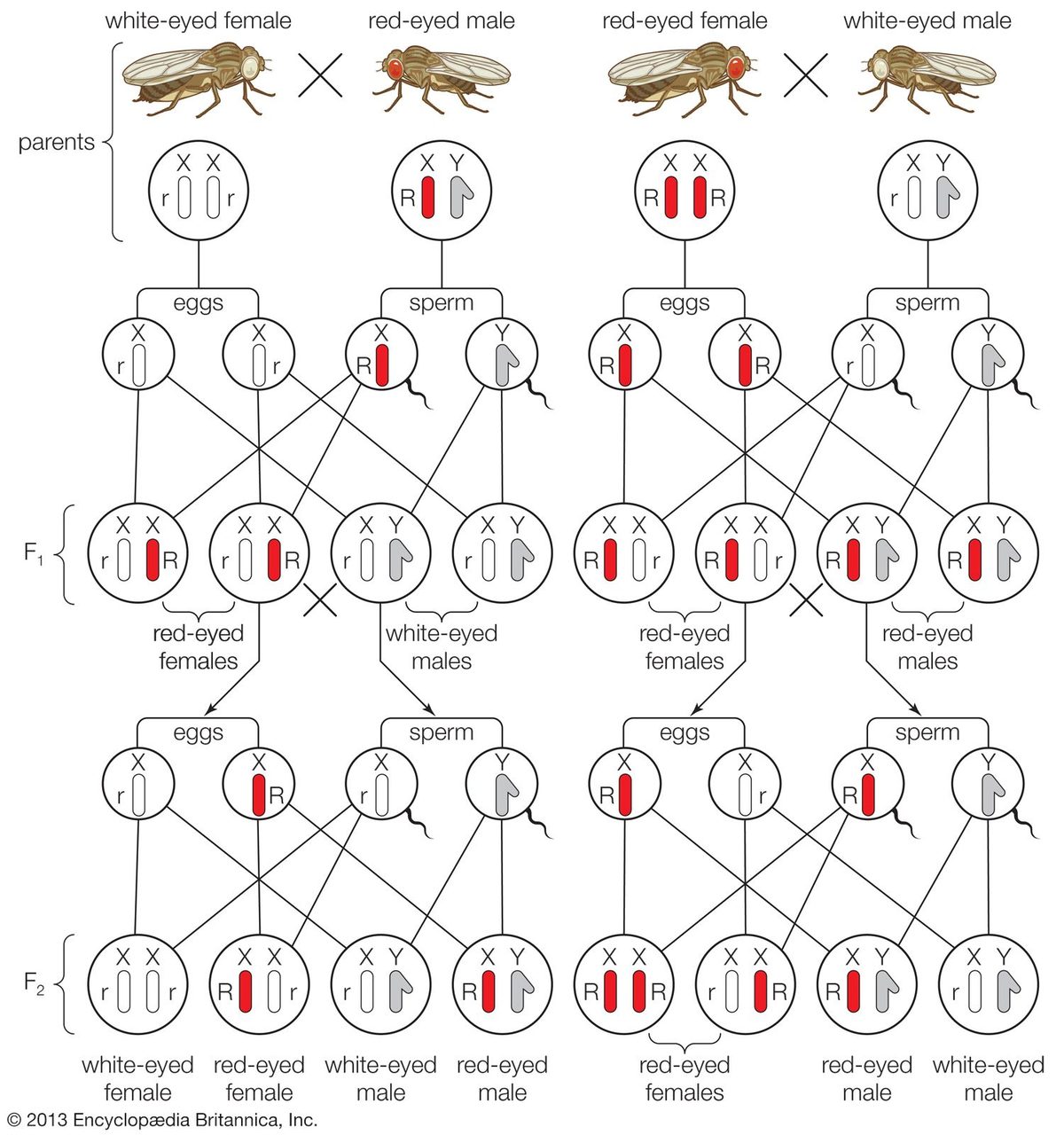

By 1908, Thomas Hunt Morgan was deeply involved in breeding fruit flies (Drosophila melanogaster ) at Columbia University, but he was not ready to grow a single white-eyed fruit fly in thousands of flasks. This isn’t just a weird mutation. This is the key to understanding how sex determines heredity.
When Morgan bred a white-eyed male with a normal red-eyed female, the first generation (F1 ) was exclusively red-eyed. This property appears to have disappeared. But when these siblings reproduce, the second generation (F2 ) tells a different story. Some offspring have white eyes. All of them were male.
This is not random. It was a pattern.
The Sex-Linked Breakthrough
Morgan didn’t ignore the data. He hypothesized about it. He proposed that this trait was linked to the X chromosome, a concept now called sex-linked inheritance. The logic is simple, but profound. Females have two X chromosomes and males have one X chromosome. If the white eye gene is on the X, the male will express it because there is no other X to hide it.
The evidence is piling up fast. Other variations in Morgan’s fly stock followed the same pattern. They travel together and inherit as a whole. Morgan realized that these “discrete units of heredity” (which he accepted as “genes” in Wilhelm Johannsen’s 1909 terminology) must reside in the chromosomes themselves. They are not floating abstractions. they are physical.
Morgan had long been a skeptic of Mendel’s laws and chromosome theory. Looking at the information made him change his mind. Breeding experiments and cytology (the study of cells) fit perfectly together. One can be explained by the other.
Building the Genetic Map
Morgan does not operate in a vacuum. He had a group of talented graduate students at Columbia University: A.H. Sturtevant, C.B. Bridges and H.J. Müller. Together, they turned that curiosity into a comprehensive theory of heredity.
Sturtevant made a decisive leap forward. He showed that genes can be arranged in a linear order along chromosomes. He calculated the relative distance between traits by analyzing how often they were inherited together. This creates a “map” of the chromosomes.
A cytological examination quickly confirmed this. The researchers were actually able to confirm a physical location on the chromosome that matched the location on Sturtevant’s map. This was clear proof. Mendel’s abstract factors had a concrete physical basis.
In 1915, the group published “The Mechanism of Mendelian Heredity”. This became the foundational text summarizing how genes work in multicellular organisms. Morgan also changed his position on evolution by 1916, increasingly accepting Darwin’s theories and his genetic discoveries.
From Columbia to Caltech
Although Morgan’s success at Columbia University was undeniable, he was drawn west. In 1928, he accepted an invitation to organize the biology division at the California Institute of Technology (Caltech). He also helped establish a Marine Laboratory in Corona del Mar to incorporate field biology into the curriculum.
the fly work continued at Caltech, but Morgan’s own focus shifted. He was always interested in experimental embryology. Although he understood the theoretical link between genetics and development, bridging the gap proved experimentally difficult at the time. He took a break from raising “fruit flies” daily and returned to his early passion, though he still couldn’t connect the dots.
Honors and Legacy
Morgan’s contribution was quickly and widely recognized by the scientific community.
- 1924: Darwin Medal
- 1927–1931: President of the National Academy of Sciences
- 1930: President of the American Association for the Advancement of Science
- 1932: President of the Sixth International Congress of Genetics
- 1933: Received the Nobel Prize for the discovery of the “Drosophila genetic mechanism of transmission”.
- 1939: Copley Medal from the Royal Society of London
Morgan remained on the faculty of the California Institute of Technology until his death and leaving behind a body of work that shaped biology.
He has published books in three different areas: evolution, genetics and embryology. Although Darwin strongly criticized him in his work Evolution and Adaptation (1903), he softened this position considerably in A Critique of the Theory of Evolution (1916). His writings on heredity, especially Heredity and Sex (1913) and The Theory of the Gene (1926), supported Mendel’s framework for all complex life. Meanwhile, Embryology and Genetics (1934) represented his continued, albeit incomplete, attempt to connect genetic theory with physical developmental processes.
White-eyed flies are a slight anomaly. The map it helped create was enormous. What is the relationship between genes and the developing embryo? The story is just beginning.


