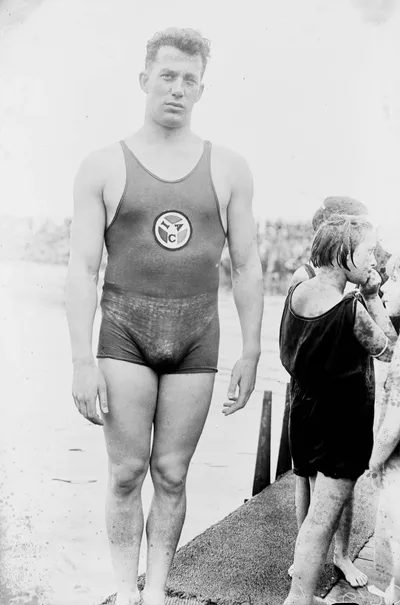
Norman Ross was not just a swimmer. He was a force of nature in the water and a disruptor on land. Born in Portland, Oregon, in 1896, he became one of the most decorated athletes of his era before becoming the first classical music disc jockey in America.
His story starts with raw talent. Ross attended Stanford University, where he honed his craft. By 1916, he had already set his first world record in the 220-yard freestyle. It was a sign of things to come. The next year, he claimed the Amateur Athletic Union (AAU) national outdoor champion title in the 440-yard race. He kept that crown in 1920. He also added the AAU one-mile outdoor championship to his belt that same year. Four indoor AAU championships followed. He was dominating the pool.
But Ross did more than just swim fast. He served in the U.S. Army during World War I. General John J. Pershing decorated him for valour. That military discipline followed him to the 1920 Antwerp Olympics.
The Antwerp Mutiny
The journey to Belgium was a disaster. The U.S. Olympic team sailed on an overcrowded funeral ship. They were given makeshift housing in an Antwerp school. The conditions were squalid. Most athletes would have stayed quiet. They wanted to keep their medals safe.
Ross did not stay quiet. He led the athletes’ rebellion against the American Olympic committee. He refused to accept the poor treatment.
Despite the chaos, he dominated the water. He won the 400-metre freestyle race. He won the 1,500-metre freestyle race. He also swam on the victorious 4 × 200-metre relay team. That is three gold medals. He also competed for the U.S. water polo team, which won a bronze medal.
A Legacy of Stamina
Ross was noted for his incredible stamina. He set individual world records in the 400- and 800-metre freestyle races. He also set records in races that are now discontinued. The 220-, 300-, 440-, 500-, and 880-yard freestyle races. The 300- and 500-metre freestyle races. He set more than 10 world records in total.
His career extended far beyond swimming. During World War II, he served as an aide to James H. Doolittle, a U.S. Army Air Force general. Later, he found a different kind of spotlight. He became the first classical music disc jockey in America. He broadcast for years on a Chicago radio station.
Ross died in Evanston, Illinois, on June 19, 1953. He received a law degree from Northwestern University after his swimming days. But his name remains tied to a specific moment in Olympic history. It is the moment an athlete decided that dignity mattered more than protocol.
He led the athletes’ rebellion against the American Olympic committee. Despite the difficult conditions, he won the 400-metre and 1,500-metre freestyle races.