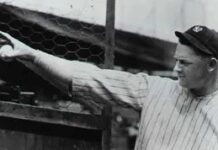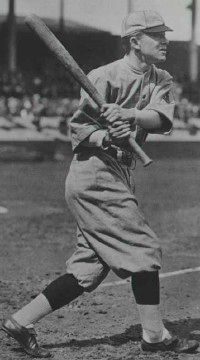
The year was 1920. The New York Yankees had just acquired a player from the Boston Red Sox who was less a baseball player and more a natural disaster in pinstripes. Babe Ruth didn’t just play the game; he exploded onto it.
By July, the Polo Grounds were vibrating with a fever that hadn’t been seen before. On July 9, the city officially declared “Babe Ruth Day.” The Knights of Columbus handed him a diamond-studded watch fob. Ruth homered. He tipped his cap while rounding the bases. It was theater. It was religion.
“I’d have ridden on horseback all the way to St. Louis to see you hit them home runs.”
Crowds were massive. Not just big. Record-shattering huge. Five of seven American League cities saw their largest turnouts ever. You had great-grandfathers standing shoulder-to-shoulder with toddlers. Everyone wanted the same thing. They wanted to see the ball fly.
In St. Louis, the obsession reached absurd heights. Three cowboys showed up in the Yankees’ locker room. They told Babe they had ridden for three days to reach a Wyoming rail station. They took a train to Missouri. One of them, supposedly, said they would have ridden horseback all the way to St. Louis just to watch him hit.
It wasn’t just awe. It was visceral. A man in Washington took the excitement too far. He had a heart attack after seeing Ruth launch a home run and died on the spot. Children followed him everywhere. He was surrounded by them. It was a showman’s dream and a manager’s nightmare.
Building Murderer’s Row
Pitchers didn’t want to face him. They walked him. A lot.
These weren’t accidents. Many were intentional. The strategy was simple: if you can’t strike him out, don’t give him a hit. Give him a walk. The statistic for intentional walks didn’t exist yet. You just saw it happen.
When the walk rate got out of control, Yankees manager Miller Huggins made a move. He shifted Ruth from the fourth spot to the third in the batting order. He put young slugger Bob Meusel at cleanup.
Did it work? Sometimes. On July 11, Ruth hit a homer off Howard Ehmke of Detroit. But in the other three at-bats? He was walked on four straight pitches. In the entire game, he swung at the bat twice.
The team still won. The Yankees had an elite pitching staff. Carl Mays had arrived and quickly became the ace. He joined Bob Shawkey (who led the league in ERA with twenty wins), Jack Quinn, and Rip Collins. Ernie Shore filled in when needed.
The lineup was stacked. First baseman Wally Pipp was a consistent hitter. Catcher Muddy Ruel was promising. Del Pratt, Roger Peckinpaugh, and Aaron Ward held down the infield. The outfield had Ping Bodie, Duffy Lewis, and Bob Meusel.
Before Ruth even arrived, a newspaper cartoonist had dubbed this group “Murderer’s Row.” They were dangerous. Ruth made them legendary.
On July 15, Ruth tied the record of twenty-nine home runs with a blast off Bill Burwell at the Polo Grounds. Four days later, in a doubleheader against the White Sox, he smashed three more. He set a new record. Again.
By July, he had thirty-seven homers. The Yankees drew nearly 200,000 fans during a seven-game homestand. That number was unheard of. The American League pennant race was tight. New York, Chicago, and the Cleveland Indians were battling for supremacy.
The Fatal Pitch
The tension carried into August. The Indians held a slim lead. On Monday, August 16, they came to New York for a three-game series. They were four percentage points ahead of Chicago and a half-game ahead of the Yankees.
Soft rain fell early. Cleveland led 3-0.
Ray Chapman, the Indians’ shortstop, stepped up to the plate. He faced Carl Mays. Mays had an eighteen-win season and a reputation for being tight. He threw an underhand windup.
Chapman leaned over the plate. He took the first pitch. He awaited the second.
Mays delivered a fastball. High and inside.
It struck Chapman in the left temple. The impact was brutal. Chapman froze. The ball bounced toward the pitcher. Muddy Ruel, the Yankees’ catcher, picked it up. He fired it to first base. He thought he had made the first out of the inning.
Chapman fell into a sprawling position inside the batter’s box. Blood oozed from his ear. Ruel realized something was wrong. A doctor was called from the stands.
Ruth watched from the outfield. Chapman managed to get to his feet. He couldn’t speak. He was taken to the visitors’ clubhouse. The doctor determined that emergency surgery was needed to relieve pressure on the brain.
Baseball continued. The Yankees missed a chance to take first place. They lost 4-3.
It wasn’t until after the game that players learned Chapman had been taken to St. Lawrence Hospital. Doctors operated later that night. At 4:40 the next morning, Ray Chapman died.
He suffered an intracranial hemorrhage. He was the first major leaguer killed by a pitch. The only one.
The Finish
The Yankees postponed the next day’s game. They split two 4-3 contests. Ruth hit his forty-third home run in one of them. They stayed one and a half games out.
People demanded Carl Mays be banned. Sportswriters and opposing players called for his banishment. Mays had scuffed balls. He pitched tight. But he stayed with the club.
He won eight games down the stretch. The Yankees briefly took over first place.
Ruth had a slow August. He hit only six homers. But he rebounded. He hit ten homers in his final twenty-four games. It was one of the best power surges of his career.
It wasn’t enough. The Yankees stumbled on their final western swing. They finished three games back. The season ended. The history was written.
The Charity Road Trip and Ruth’s Historic 1920 Campaign
The 1919 Yankees didn’t win the pennant. They finished with a franchise-best 95-59 record, but that wasn’t enough to secure the title. Yet, the end of that campaign offered a surprisingly bright finale. While on their final road trip, the Yankees traveled with Brother Matthias and a youth band from St. Mary’s Industrial School. The boys weren’t just making music. They were there to raise funds to rebuild their institution after a devastating fire in April of that year.
Ruth made the arrangement. He had the group join them in Cleveland, Detroit, and Chicago. The result? St. Mary’s netted over $13,000 in donations. Ruth pitched in $4,100 of his own money. That was a fifth of his salary. He also posed for photographers, wielding a tuba and playing the part of the benevolent star. It was a colorful exit to a summer that would soon ignite a revolution in baseball.
How Dominant Was Babe Ruth in 1920?
The Yankees would have to wait another year for a pennant. But Ruth’s individual performance in 1920? It was unlike anything the sport had ever seen. He hit 54 home runs. That single total was higher than the combined home run totals of 14 out of 15 other American League teams. The only team with more was the Philadelphia Phillies, and even they only managed 64.
Ruth accounted for one out of every seven home runs hit in the AL that year. Compare that to the competition. George Sisler, the runner-up in the AL, had just 19. Cy Williams led the National League with a mere 15. In fact, only 15 major leaguers hit ten or more home runs that entire season. Ruth wasn’t just leading the league. He was operating on a different plane entirely.
His other statistics backed up the power. He led the AL with 137 RBIs and 158 runs scored. He hit .376, which ranked fourth in the league. He also added 36 doubles, nine triples, and 14 stolen bases. This wasn’t just brute force. It was proof of a strong, intelligent athlete at work.
The Slugging Record That Stands Alone
Perhaps the most staggering number from his 1920 season was his slugging percentage. Ruth posted an .847 mark. It set a major league record that still stands today. No other player has ever come within 75 points of that figure. The gap is massive.
Analysts often point to rule changes as the reason for such dominance. The banishment of the spitball and other trick pitches opened up the game. There were also unsubstantiated rumors of a “juiced” baseball, contributing to a dramatic rise in league averages over the previous year.
But did the rules or the ball explain Babe Ruth? Probably not. What he did went beyond technical explanation. For the crowds packing the Polo Grounds all season long, the mechanics didn’t matter. They just loved what they were seeing.
Attendance Records and the Birth of a Phenomenon
The economic impact was immediate and staggering. The Yankees more than doubled their attendance figures. They drew a major league record 1,289,422 fans. They became the first team in baseball history to surpass one million in attendance.
This wasn’t just a Yankees phenomenon. Seven other major league teams set their own attendance records that season. Much of that credit went to Ruth. In an era defined by giants like Ty Cobb, Walter Johnson, and Tris Speaker, the Babe was the most popular player in the game. He was the biggest drawing card in all of sports.
Ruth sensed the shift in his favor. He thought himself no longer naive. He was ready to capitalize. Following the season, he earned several thousand dollars in exhibition games. He then signed on with John McGraw for a barnstorming tour of Cuba. The team was mostly Giants players. Ruth brought his wife, Helen, along for the trip.
The payout was significant. He made anywhere from $25,000 to $40,000 for those games. But Ruth had other interests. He discovered he liked the excitement of putting money on the nose of a horse. He ended up losing at least that much of his earnings.
Accounts vary on how this happened. Some suggest he was set up by swindlers claiming to have “insider information.” Whatever the case, Babe enjoyed the gamble. He weighed 240 pounds when he came home. The spring was approaching. He was ready to take up right where he left off, determined to prove the 1920 season was no fluke. It was just the beginning.