Traditional medical imaging is like looking at a map of a city from space: you can see the buildings (tumors), their size, and their location, but you cannot see what is happening inside them. For oncologists, this limitation creates a dangerous blind spot. A tumor might shrink slightly in size on a standard MRI, yet remain biologically aggressive and resistant to treatment. Conversely, a tumor might stay the same size while the therapy successfully kills the cancer cells, causing them to become dormant.
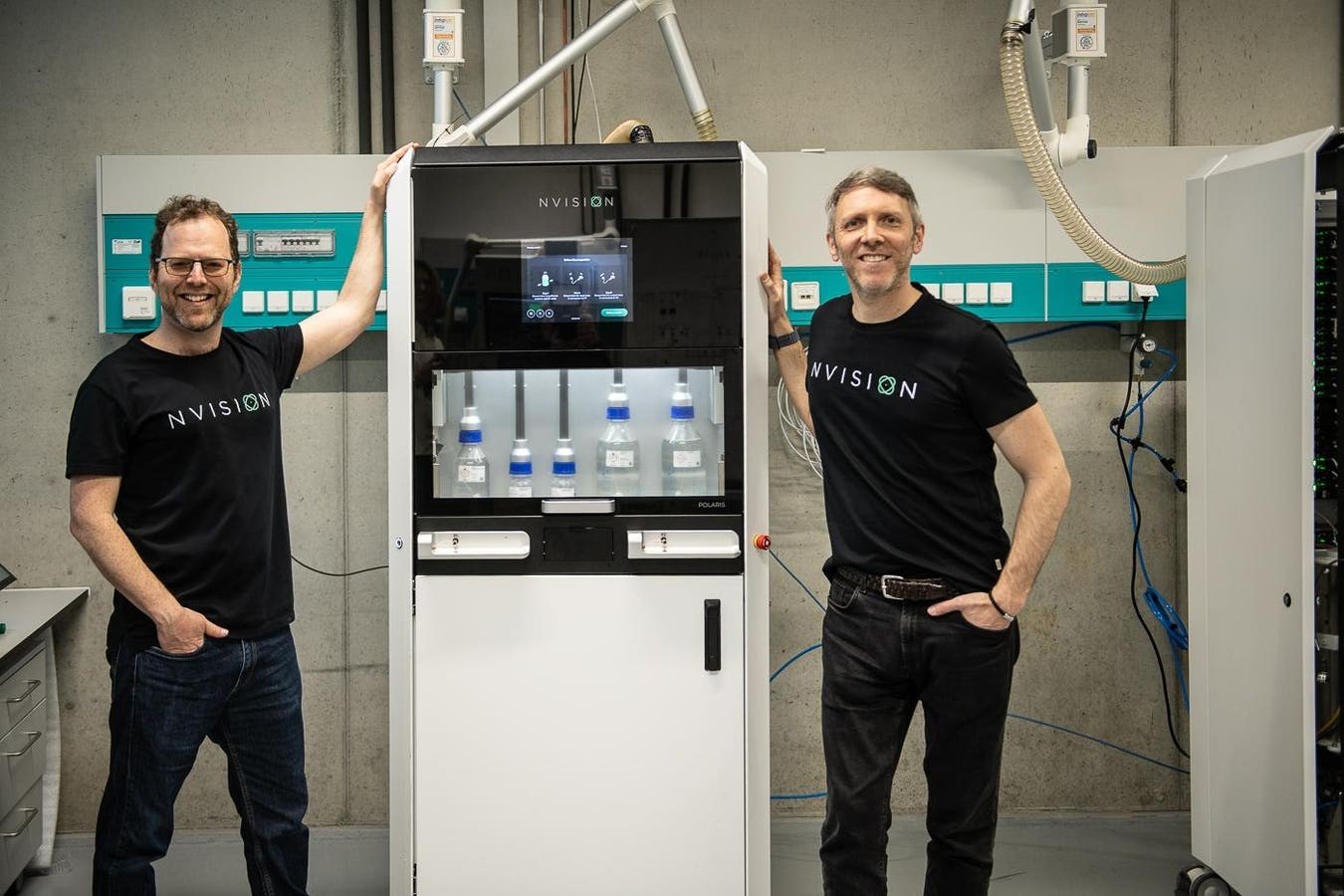
This gap between anatomical changes and biological reality is what NVision Quantum Technologies, a German startup valued at over $250 million, aims to close. By leveraging quantum physics to visualize cellular metabolism, NVision is transforming how doctors monitor cancer treatment, shifting the timeline from months of uncertainty to days of actionable data.
The Metabolic Advantage
The core innovation lies in how cancer cells behave differently from healthy ones. Cancerous cells consume sugar (glucose) at a significantly higher rate to fuel their rapid growth—a phenomenon known as the Warburg effect. While PET scans already use radioactive tracers to detect this sugar consumption, they lack the spatial resolution and real-time clarity needed for precise monitoring.
NVision’s technology enhances the magnetic signal of these sugar molecules by more than 10,000 times. This amplification allows standard MRI machines to visualize metabolic activity with unprecedented precision.
“The areas that are black are what will kill you. The green is indolent… We can’t just understand one tumor or one blood sample. We have to understand the tumor’s ecosystem,” explains Kayvan Keshari, a researcher at Memorial Sloan Kettering Cancer Center who helped integrate the technology into clinical practice.
This capability addresses a critical pain point in oncology: the lag time in feedback. Currently, patients and doctors often wait months to see if a drug is working by measuring tumor size. NVision’s system detects metabolic changes—often the first sign of therapeutic success or failure—within days. This speed allows for rapid adjustments in treatment plans, potentially saving patients from ineffective therapies and reducing the time cancer has to progress.
Scaling Up with Strategic Capital
NVision’s potential has attracted significant institutional support. The company recently raised $55 million in new funding, including a $38 million lead investment from Abbott, the global health diagnostics giant. The remaining $17 million came as a venture loan from the European Investment Bank. This round brings NVision’s total equity investment to $74 million and values the firm at over $250 million.
While modest compared to AI-driven tech valuations, this capital is crucial for a hardware-heavy biotech startup. The funds will accelerate the rollout of its metabolic imaging systems across top-tier medical centers. By the end of the year, NVision plans to deploy its technology in 20 centers across the U.S., Europe, and Asia, including prestigious institutions like MD Anderson, UCSF, and the University of Cambridge.
Regulatory milestones are also approaching. NVision is currently in discussions with the FDA and other global regulators, with human clinical studies expected to begin in 2027.
From Imaging to Drug Discovery
NVision’s ambitions extend far beyond diagnostic imaging. The company is pivoting its quantum research toward a second major frontier: drug development.
The path to this breakthrough was unconventional. NVision’s founders originally explored using defects in diamonds and organic molecules for imaging. While those specific approaches did not scale for clinical use, they led to a significant discovery in quantum computing. NVision researchers developed a method to build quantum computers using standard semiconductor manufacturing technology—a feat that has largely remained theoretical in academic circles.
This hardware breakthrough allows NVision to simulate molecular interactions with high precision. The company plans to use this quantum computing power to design therapies for previously “undruggable” targets —proteins or pathways that were too complex or unstable for traditional drug design.
The synergy between the two technologies creates a closed-loop system:
1. Design: Use quantum computing to model and design potential drug candidates.
2. Validate: Use metabolic imaging to test the efficacy of these drugs in real-time on patients.
“We will use this with patients, but we see this as an important tool to validate the efficacy of drugs,” says Sella Brosh, NVision’s CEO. “The goal is to shorten the time and expense it takes to get a would-be drug into late-stage clinical trials.”
A Journey of Persistence
The road to this point was not straightforward. Founded in 2015 by physician Sella Brosh and physicist Ilai Schwartz, NVision emerged from the University of Ulm in Germany. Early attempts to create room-temperature metabolic imaging faced significant engineering hurdles. Previous systems, such as one introduced by GE in 2014, required temperatures near absolute zero (-460°F), making them impractical for hospital use.
Schwartz and Brosh spent years refining their approach, eventually settling on a technology utilizing quantum-engineered hydrogen gas. The journey required patience and multiple pivots. “If we weren’t patient with the physics, they would have run out of money twice years ago,” notes Peter Barrett, a general partner at Playground Global who invested in the company nearly nine years ago.
Why This Matters
NVision’s technology represents a shift from reactive to proactive oncology. By visualizing the biological activity of tumors rather than just their physical dimensions, doctors can make more informed decisions about who needs aggressive treatment and who can safely undergo “watch and wait” monitoring. This is particularly relevant for diseases like prostate cancer, where over-treatment of indolent tumors is a common clinical dilemma.
Furthermore, the application of this technology is not limited to cancer. Metabolic changes are early indicators of various diseases, suggesting potential applications in cardiology and neurology.
“We are measuring tumors with rulers, yet we drive electric cars and have rocket ships that go to Mars,” says Keshari. “We have the opportunity to change that.”
Conclusion
NVision Quantum Technologies is bridging the gap between physics and medicine, offering a clearer, faster, and more biologically accurate view of cancer. With strong backing from industry leaders like Abbott and a dual focus on diagnostic imaging and drug discovery, the company is positioning itself to redefine the timeline of cancer care. By detecting treatment response in days rather than months, NVision promises not only to improve patient outcomes but also to accelerate the development of new, effective therapies.