Look at your childhood photos. Or better yet, ask a guy who grew up in the 1970s to roll up his sleeves. Chances are high you’ll see the evidence. It is a badge of honor for kids of that decade. Between slicing up Stretch Armstrong and waiting for the next Star Wars sequel, they idolized a daredevil who exploded into the public consciousness in 1967. They wanted to be him. They tried to be him. And many still carry the scars of an Evel Knievel imitation stunt gone wrong.
Long before Johnny Knoxville or Steve-O convinced Generation Y to film dangerous antics for YouTube views, Knievel-inspired jumps kept emergency rooms in the 1970s bustling. Those kids are in boardrooms now. They wear suits. They tie ties. Underneath the corporate armor, many still bear the marks of broken bones and failed leaps.
Getting hurt didn’t mean the attempt failed. Knievel himself spent more time in hospitals than on stage. He once claimed he was “nothing but scar tissue and surgical steel.” The man broke bones as often as he broke viewership records. His stunts were cultural events. They inspired songs, merchandise, and a wave of imitators. He even dragged motorcycles into the American mainstream.
But the fame masked darker patches. Years of physical abuse took a toll. His personal life crashed as often as his motorcycles. He was a daredevil in the air and on the ground.
There is more to the legend than vintage lunchboxes or VH1 nostalgia trips. The story is grittier. It is messier. Here is the real breakdown.
Early Life and the Making of a Daredevil
Robert Craig Knives, better known as Evel Knievel, was born in 1938 in Butte, Montana. He was not born with a death wish. He was born with a need to escape. His father died when he was young. His mother struggled to make ends meet. The streets of Butte offered little hope.
He found speed early. He learned to ride on a broken-down motorcycle he rebuilt piece by piece. The machine was unreliable. The crashes were frequent. This was his education. He learned that falling was inevitable. The trick was how you got back up.
By his late teens, he was working as a mechanic. He fixed what he broke. He also started entering motorcycle races. He was good. Too good for his own good. He began taking risks that locals called suicide runs.
His first major jump was in 1964. He cleared 12 cars in a sidecar. It was small. It was local. But it worked. He felt the rush. The crowd roared. He knew then what he had to do next. He needed bigger gaps. Bigger risks. A bigger name.
He changed his name from Knieves to Knievel. It sounded tougher. It sounded American. He began traveling across the country, setting up jumps in town squares. He wore leather. He wore a helmet. He looked the part. The media caught on. The public loved it. The danger was the point.
Knievel understood something most stuntmen missed. It wasn’t about the jump. It was about the
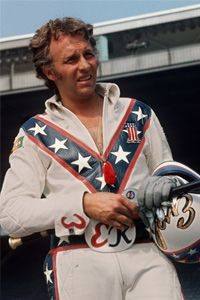

Robert Craig Knievel didn’t stick to the name. Born in 1938 in Butte, Montana, he was raised by grandparents after his parents split and faded from his life. The moniker that stuck came from the Butte cops. They called him “Evil Knievel” after arresting him for stealing hubcaps. He later changed it to “Evel,” dropping the ‘i’ because, as he put it, it just looked better.
The hubcap thefts were just the start. He claimed to have stolen a Harley-Davidson at age 13. Joie Chitwood, a stunt-car legend, inspired the move. But Knievel wasn’t just a troublemaker. He was a solid high school athlete. He played semi-pro hockey. In the 1950s, he joined the Army as a paratrooper. He made over 30 jumps. The risk came naturally.
His leap into the spotlight started with a motorcycle shop in Washington state. He needed to draw a crowd. So he jumped his bike over parked cars. The first attempt cleared 40 feet. He landed short. Right into a box of rattlesnakes. There was a tethered mountain lion nearby. The stunt worked. It built a team of motorcycle daredevils who crisscrossed the western United States.
Then he went solo. He picked a target. The fountains in front of Caesars Palace in Las Vegas, Nevada.
New Year’s Eve, 1967. The crowd counted 15,000 people. The gap was 151 feet. He mounted the ramp. He revved the engine. His pre-jump ritual was simple. A prayer. “God, take care of me. Here I come…”
The bike shot into the air. The crowd held its breath. Did he make it?
The clock struck midnight on New Year’s Eve, 1967. Las Vegas was holding its breath. At Caesars Palace, Evel Knievel revved his engine, aiming to clear the grand fountain. He made it across the 151-foot gap. He just didn’t survive the landing.
The motorcycle flew. Knievel flew off it. He slid 165 feet across the concrete like a ragdoll. The crash broke his skull. It shattered his pelvis. It cracked his ribs. He lay in a coma for nearly 30 days. Millions of Americans watched the disaster on television.
It should have ended his career. It didn’t.
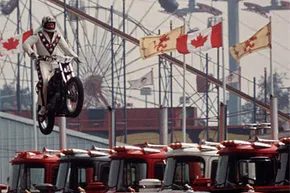
The failure didn’t matter. The stunt turned him into a national obsession. He became a regular on ABC’s Wide World of Sports. From 1973 to 1976, he appeared seven times. He jumped over wrecked cars. He soared past double-decker buses. Those episodes rated higher than almost anything else on the network.
The Snake River Canyon Disaster
By 1974, Knievel needed to go bigger. He chose the Snake River Canyon in Idaho. The payout? $6 million. A massive sum for the time. The obstacle? 1,600 feet of open air.
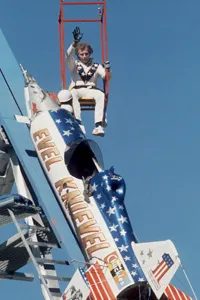
He built a custom machine. The Skycycle. It was a rocket-propelled motorcycle. The launch was clean. The physics worked. Then, the chute opened too soon. The jet-bike drifted down. It never reached the other side.
It wasn’t the only miss.
The Wembley Stadium Crash
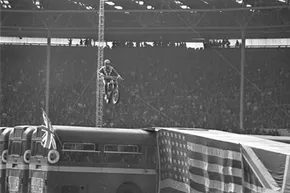
London’s Wembley Stadium. 70,000 fans packed the stands. The plan was simple. Jump 13 buses. Knievel hit the ramp at 90 mph. He cleared the 13th bus. Barely.
The landing? Terrible.
But the aftermath was worse. The crash broke his hand. It crushed his pelvis. It compressed his vertebrae. Fans expected a heroic speech. They got something else.
What did he say in those first, painful minutes? The daredevil’s true motive wasn’t revealed by the stunt itself. It was revealed by the words he chose when he could barely move.

The Wembley Wreck and the Lies That Followed
Seventy thousand fans packed London’s Wembley stadium. Millions more watched on ABC’s Wide World of Sports. The plan was simple. Jump thirteen buses. Make history. Instead, Evel Knievel crashed on the landing. The Harley-Davidson motorcycle slammed into him instantly. Medics rushed in. They expected him to be carried out.
He refused.
He walked out on his own two feet. Asked for a microphone. The crowd held its breath. He told them they were witnessing his final jump. “I will never, ever, ever, ever jump again,” he said. “I am through.”
His body was broken. His words were lies.
Five months later. Kings Island Amusement Park in Ohio. Fourteen Greyhound buses. He cleared them. The broadcast became the highest-rated telecast in ABC’s Wide World of Sports history.
The Business of Danger
Popularity wasn’t just a side effect. It was the product. Knievel claimed his toys grossed over $300 million. Two biopics. Three starring roles. He lived the brand. Of the seven jumps he made for Wide World of Sports, five actually worked.
But the toll was brutal. More than forty broken bones in his lifetime. Not just in the stunts. In life too. 1977. Convicted of beating his former press agent. Six months in jail. Financial mismanagement drained his earnings. By 1980, his body finally said stop. He retired from performing.
He didn’t stop showing up. Personal appearances. Promoting his son, Robbie Knievel, who had already started following in his father’s tire tracks. But the hard living caught up. A heavy drinker. Hepatitis C. A liver transplant in 1999.
The Legacy of the Fall
November 30, 2007. The man who defied canyons, buses, and shark tanks couldn’t outlast his own biology. Diabetes. An incurable lung condition. A career of hard landings. He was sixty-nine.
He left behind four children. Ten grandchildren. One great-grandchild.
But the family isn’t the only thing that remains. References to Knievel are everywhere. “The Simpsons.” A Kanye West video. MTV’s “Jackass” is a direct descendant of his showmanship. It understands what he knew all along. Some people watch stunts to see success. Others watch to see failure.
In 2005, Ideal Toys re-released the Evel Knievel Stunt Cycle. Kids who played on their living room floors in the seventies could finally share that play with their own kids. The 1972 Harley-Davidson XR-750 sits in the Smithsonian’s National Museum of American History. He is sometimes called “The Father of the X Games.” Every summer, Butte, Montana, hosts Evel Knievel Days. Incredible motorcycle stunts.
Robbie’s Scorecard
Robbie Knievel didn’t just watch. He did. He has successfully performed all but two of his father’s stunts. The Wembley Stadium jump. The Snake River Canyon jump. He left those ones alone.
Kids from the seventies don’t need a history book. They need to look at their scars. The ones on their elbows. The ones on their knees. They remember the feeling of flying through the air. They remember missing the landing.
Jump over to the next page for more information.