


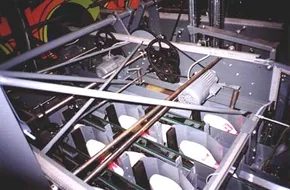
Back in the day, clearing a lane was manual labor. Real labor. You had workers standing behind the pins, physically lifting them, resetting their positions, and tossing the heavy wooden spheres back to the bowler. It was slow, sweaty, and frankly, a bottleneck for the sport.
Then came the machine. The automatic pinsetter changed everything. Gottfried Schmidt patented the concept, and in 1946, the American Machine and Foundry Company (AMF) dropped their first model into alleys worldwide. It was a beast. We’re talking nearly two tons of steel. It stood nine feet tall. It didn’t just set pins; it dominated the back end of the lane.
Today? The machines are smaller. Smarter. Faster.
Modern pinsetters don’t just reset pins. They scan the lane. They separate standing pins from debris. They drop a fresh triangle into place with millimeter precision, all while the computerized scoring systems track strikes, spares, and frame counts in real-time. This isn’t just mechanical convenience. It’s the reason tenpin bowling became a global sport.
The Tenpin Standard
You know the setup. Ten pins. White. Usually. Arranged in a triangular rack at the end of a polished wooden lane. You roll the ball. You try to knock them all down.
If you miss? The gutters on either side catch your error. They’re those deep trenches that swallow balls meant for the wrong lane. A full game has 10 frames. That’s it. Ten chances to break the sound barrier of pins.
The pinsetter’s job is simple but critical. After every roll, it clears the dead wood. It checks for standing pins. It resets the rack for the next shot. Without it, you’d be walking back there with a broom and a wrench after every single throw. Nobody wants that. Nobody needs that.
Cosmic Bowling and the Tech Upgrade
In the late 1990s, bowling centers tried to stay relevant. They called it Cosmic Bowling. Or Extreme Bowling. Same idea. Strobe lights. Fog machines. Neon pins that glowed under blacklight. Loud music pumping through the ceiling. It was an attempt to pull younger crowds off the couches and onto the approach.
But the real revolution wasn’t the lights. It was the machinery. As demand for faster play grew, so did the technology. Early pinsetters were loud and crude. Today’s units are silent, efficient, and integrated directly with the lane’s electronic scoreboard.
As the Pins Fall
What actually happens when the ball hits the pins?
It’s not magic. It’s engineering.
The ball impacts the head pin. The energy transfers. The triangle collapses. Some pins fly. Some spin. Some stand.
The pinsetter doesn’t wait for the dust to settle. Sensors detect the result. If it’s a strike? The machine clears all pins instantly. If it’s a split? It identifies which pins remain standing. It separates the living from the dead. It lifts the standing ones, drops the fallen ones into a collection bin, and drops a new set into place. All in seconds.
This speed is why you can bowl 300 games in a weekend. This efficiency

The Brunswick GSX: Inside the Machine
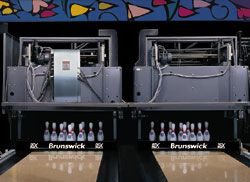
The pinsetter waits. Silent. Stationary at the lane’s end. It’s just a machine, really, but the Brunswick GSX pinsetter is one of the latest heavyweights in the industry. You might not notice it until you hear the clatter, but behind that noise is a complex dance of mechanics.
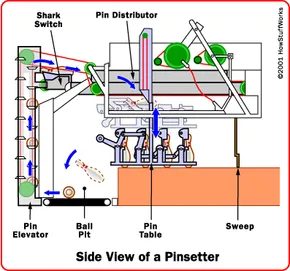
Four main systems drive the action. The sweep clears debris. The pin elevator lifts the dead wood. The pin distributor sorts them. And the pin table prepares the stage. All told, over 4,000 individual parts work together to reset the pins after every roll. That is a lot of moving metal for a game that looks this simple.
Here is the thing about automatic pinsetters: they never sleep. They handle 20 pins at once, which is double the number standing on the lane. Why? Because the machine needs extras. It works in cycles, strict procedures triggered the moment a ball crosses the foul line. To react fast, the GSX needs to know exactly what happened down there. Strike? Spare? Gutter ball?
Modern versions rely on a small CCD scanner camera mounted farther down the lane. The camera snaps a quick read of the pin layout and sends the data to the unit. Older models did it differently. They lowered themselves onto the lane, using metal “fingers ” to poke and prod, checking for standing pins by touch. Newer GSX units still keep those fingers as a backup. If the camera glitches, the fingers step in. The machine has to be ready for anything.

The routine changes depending on what happened in the previous roll. Most amateur bowlers fall into the “first ball – standing pins ” pattern. This is the most common scenario. It happens when a bowler takes the first roll and takes out anywhere from one to nine pins. The machine has three jobs to do. It needs to grab the pins left standing. It has to clear the deadwood. And it must reset the lane for the second shot.
The machine wakes up the moment the ball hits the pit. A sensor located just feet in front of the pins detects the roll. It waits. Maybe a second. Maybe two. That delay lets the ball smash into the pins and tumble into the ball pit. That pit is the dark hole behind the rack. It takes the initial shock of the impact.
Once the sensor confirms the ball is safe, the sweep moves. It drops into a “guard” position. This is a flat metal sheet. It sits in front of the pins. It protects the delicate machinery behind it. If a bowler throws a wild ball, the sweep stops it. It also stops cheaters from sneaking in extra rolls. With the lane secured, the pin table descends. This table has ten holes. Each one is shaped exactly for a pin.
Now the machine counts. If the system has a CCD camera, it looks. If not, it relies on the angle of the pins. The software calculates if there are between one and nine pins left. This data goes to the scoring computer. Then the spotting tongs snap shut. A solenoid drives the metal claws around the standing pins. The table lifts. The pins are secured.
The lane is clear of standing threats. Now it is time to remove the debris.
Clearing the Lane
The sweep that was guarding the pins now retracts. It drags back and forth. Just once. It sweeps the deadwood —the knocked-down pins that didn’t make it to the pit—off the lane. These pins slide onto a conveyor belt. The belt carries them back to the pin elevator. That elevator stores them for the next frame.
Once the sweep finishes, it returns to its guard position. The pin table lowers again. This time, it hovers over the empty spot where the pins used to be. The table has the remaining pins held tight in its claws. It positions them perfectly. Then, a switch flips open. The tongs release. The pins stay on the wood. The table rises back to its start position.
Here is where the technology matters. If the machine has a camera, it can preload the next frame. It allows ten fresh pins from the elevator to fill the pin table while the bowler is still taking their second roll. This saves time. Older machines without cameras have to wait. They must lower an empty table after the second shot just to count how many pins fell. They can’t work ahead.
Faster Cycles and Modern Tech
The presence or absence of a camera determines the next loop. With a camera, the cycle is simple. Sweep the pins. Place ten new ones. Reset. Without it, the machine has to pause. Wait for the second roll. Count the pins. Then decide.
There are other loops too. Machines have presets for fouls. There are cycles for out-of-range pins that roll into the gutter or side channels. But the real innovation is in the short cycle. Newer pinsetters use computer logic to skip steps. If the 7-pin or 10-pin falls on the first roll, or if the bowler misses entirely, there is no deadwood. No pins to sweep. The machine skips the sweeping motion. It saves time. It saves wear on the gears.
This efficiency is huge. Consider the National Bowling Stadium in Reno. They call it the “Taj Mahal of Tenpins.” It has 78 lanes. It has an IMAX theater. It has the world’s longest video screen running above the lanes. But even there, speed matters. The AMF 8800 Gold Edition holds the world speed record for a strike cycle. It does it in 8.5 seconds.
Most bowling pinsetters contain over 4,000 individual parts.
The history is just as complex. In 1841, Connecticut made ninepin lanes illegal. Gambling was the issue. The gameshows like “Bowling for Dollars” took over in the 1950s. They were huge. Now, the machines are quieter. Faster. Smarter. They handle the chaos of thousands of strikes and spares without breaking a sweat.
But what about the sound? The crash of pins hitting wood? That’s the part the machine doesn’t control. You do.

The Hidden Mechanics of Ball Return
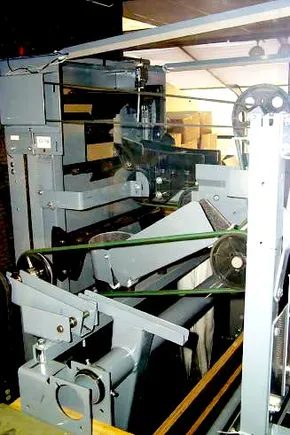
While you’re focused on your stance and follow-through, two major mechanical functions are working behind the scenes: the ball accelerator and the pin elevator. These systems keep the game moving, but they operate entirely out of sight.
Once the ball crosses the foul line and strikes the pins, both the ball and the scattered wood end up in the ball pit at the bottom of the lane. It looks like a chaotic drop zone, but it’s actually the start of a highly coordinated sorting process.
Beneath that pit lies the transport band, a conveyor belt that moves everything toward the pin elevator. This is where the magic happens. The pins are funneled up and away to be reset, but the bowling ball takes a completely different path.
At a specific point along the transport band, the ball veers off through a specialized ball door. The mechanism is simple but effective: only a bowling ball is heavy enough to trigger the sensor that opens this door. Lighter pins or debris don’t register, so they continue on to the elevator.
Once the ball passes through, it enters the ball accelerator —a conveyor system running underneath the lane. It zooms back toward the foul line, ready for your next turn. You barely notice the delay because the whole cycle is designed for speed.
The ball is heavy enough to trigger the sensor, ensuring only it enters the return path.
This separation is what keeps the lanes running smoothly. Without the weight-sensitive door, the return system would clog. The next time you grab your ball, remember: it just took a detour under the lane while your pins were being reset upstairs.
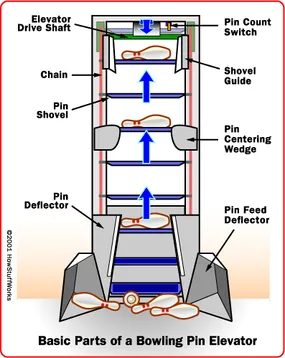

The journey doesn’t stop at the transport band. Those metal pins keep rolling, funneling straight into the pin elevator’s mechanism. It’s a simple setup, really. A dozen trays ride on two pulleys, lifting the debris and debris-free pins up toward the pin distributor.
Think of it as the vertical lift to the next stage. The pins climb, shuffle, and settle into those trays. Then they’re hoisted up to the pin table level. That’s where the pin distributor waits. Its job? To slot fresh pins into the rack. Just in time for the next frame. If it fails, you’re standing there with an incomplete set. No pins. No game.

The Mechanics of the Drop
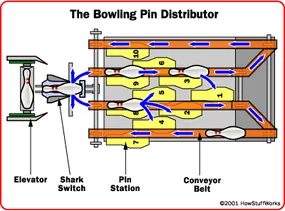
That’s how the magic happens on the approach. The distributor relies on a shark switch, a pivoting mechanism that swings a funnel-like tray back and forth. It directs the pins onto one of two conveyor belts, depending on what the electronics in the pinsetter tell it. The system knows exactly where a new pin is needed, so the switch takes its cue from those signals. Each conveyor belt features several pin stations, the designated spots where the pins settle before their final descent.
When it’s time to reload, bumper devices kick the pins off the moving belt and into those stations. The main electronics control these bumpers, ensuring they activate only where a pin is actually required. Once the new pins are loaded, the pin table pivots horizontally. This motion turns the bowling pins upright. Then, at the precise moment, the table lowers them onto the lane. Ready for the next frame.
Related HowStuffWorks Articles
-
How Golf Clubs Work
-
How Billiard Tables Work
-
How Mountain Bikes Work
-
How Fencing Equipment Works
-
How Ice Rinks Work
-
How NASCAR Race Cars Work
More Great Links
-
Brunswick Bowling
-
Bowl-Tech, Inc.
-
The History of Bowling
-
The Bowler’s Bowling Dictionary
-
How an AMF Pinsetter Works


