



Mental health struggles don’t always look like what we see in movies. Sometimes they are quiet. Internal. The kind of battle you fight in silence while the world keeps moving. But other times? They make noise. They draw stares. They leave people wondering how a life got so tangled in objects, memories, and debris.
Hoarding is one of those conditions that sits on a spectrum. For many, it starts small. A few extra boxes in the garage. A drawer stuffed with receipts you might need “someday.” It is hard to draw the line between collecting and disorder, especially when you are the one doing the collecting. You don’t see the pile growing. You only see the value in the item.
But we aren’t here to discuss the mild cases. We are looking at the extremes. The stories that hit the headlines because the sheer volume of stuff became impossible to ignore. These are five famous individuals whose hoarding tendencies reached a level of intensity that forced the world to look closer.
Bettina Grossman: Art in the Shadows
Bettina Grossman is an artist. That is the primary fact. She is also prolific.
For decades, Grossman worked in isolation. She didn’t seek the spotlight. The art world, notoriously selective and often cruel to those who don’t play the networking game, largely ignored her. Sales were nonexistent. Critics didn’t write about her. But she didn’t stop. She kept painting. Sculpting. Filming. Drawing.
The medium didn’t matter. The act of creation did.
The result was a mountain of work. Not just finished pieces, but drafts. Studies. Half-finished experiments. The debris of a creative life lived off the grid.
Her 5th-floor apartment in the Chelsea Hotel became a warehouse for her output. The walls were buried. The floors disappeared under layers of paper and canvas. She reached nearly to the ceiling.
Getting into the apartment was a logistical nightmare. Grossman spent more time in the hallway than in her own living space. She had to squeeze past the piles just to reach her bed. It was a self-imposed prison of her own making, built from love of art and a lack of distribution channels.
She remained a ghost to the public until Sam Bassett, a young filmmaker, knocked on her door. He didn’t come to judge. He came to listen. He befriended her. Then he filmed her.
The documentary, Bettina Grossman: The Life and Work of an Artist, did more than just film her apartment. It helped her organize. It gave context to the chaos. Suddenly, the piles weren’t just clutter. They were evidence of a relentless creative drive. Bassett’s work, and subsequent films about her, forced the art world to look at what they had missed.
Edith Ewing Bouvier Beale: The Grey Gardens Legacy
Before you think hoarding is a modern internet-age problem, meet Edith Ewing Bouvier Beale.
This is the story of “Grandmama,” the aunt of Jackie Kennedy. The connection alone is enough to make headlines, but the reality of her life was far grimmer than celebrity gossip.
Edith lived in Grey Gardens, a massive, decaying estate in East Hampton, New York. She lived there with
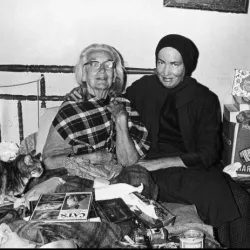

The Grey Gardens Tragedy
Edith Ewing Bouvier Beale, known to her relatives simply as “Big Edie,” and her daughter, Edith Bouvier Beale (or “Little Edie”), spent decades in the shadow of their own family’s fame. They lived in Grey Gardens, a sprawling, crumbling estate in East Hampton, New York. The name confusion was a practical necessity. The Bouvier family recycled names with reckless abandon. A documentary about their isolation later cemented their place in pop culture.
They were eccentric. They were reclusive. The house told the story.
Luxurious squalor defined their existence. Decades passed while they accumulated animals. Reports claim they harbored roughly 300 cats at various points. Raccoons slipped through holes in the roof. They were unwelcome guests in a house that barely held together.
Sanitation workers finally stepped inside. The scene was grotesque. Mounds of empty tin cans covered the floor. Fecal matter was strewn everywhere. It wasn’t just dirt. It was neglect on an industrial scale.
The mother and daughter fiercely protected their few remaining heirlooms. They didn’t want to leave. Local officials struggled to evict them. The struggle made national headlines. Why? Because they were related to Jackie Kennedy Onassis. Big Edie was her aunt. Little Edie was her first cousin. The connection brought fame to women who had lived in obscurity.
Was it hoarding disorder? Or something more complex? The sheer volume of cats suggests a psychological breakdown. Or perhaps just profound isolation. The line between eccentricity and pathology blurred completely at Grey Gardens.
The Obsessive Collector
Alexander Kennedy Miller wasn’t just a collector. He was an archivist of the bizarre.
Miller’s obsession wasn’t with art or history. It was with objects that others discarded. He built a house entirely out of the things he found. Not replicas. Real items.
His collection included thousands of pieces. Most were discarded by others. He saw value where others saw trash. This wasn’t just saving space. It was a compulsion.
The scale of his hoarding was massive. He filled rooms with items that served no practical purpose. Visitors were often overwhelmed by the sheer volume of clutter. The air was thick with the smell of old paper and dust.
Miller didn’t just collect. He curated. Each item had a place in his mental inventory. To remove an item was to disrupt the entire ecosystem of his home.
This behavior mirrors what we see in cases of severe hoarding disorder. The emotional attachment to objects replaces human connection. The house becomes a fortress against a world that doesn’t understand.
Miller’s story is a stark example of how obsession can consume a life. It’s not just about the things. It’s about the control they provide. In a chaotic world, the hoarded object is predictable. It stays exactly where you put it.
Unlike the Bouvier women, who lived in a mansion that fell apart, Miller built his world from scratch. But the end result was similar. Isolation. A life lived among things, not people.
The question remains: can you ever truly own an object? Or does the object own you?
For Miller, the answer was clear. He belonged to the collection. And the collection was endless.


Alexander Kennedy Miller didn’t just save money. He buried it.
The man was frugal to the point of misery. When he died in 1993, three years before his wife, the estate investigation revealed a man who saw value where others saw trash. Or rather, where others saw nothing at all.
His love for automobiles was public knowledge. He owned roughly 50 vehicles. Many were Stutzes, an obscure luxury car brand from the early twentieth century. But the cars were just the tip of the iceberg. Underneath them lay thousands of parts. Gaskets. Shock absorbers. Radiator caps. Engines. The sheer volume was hard to quantify because it was so vast.
Then came the money.
Investigators didn’t just find a few loose bills. They found a fortune. The couple had squirreled away nearly $1 million in gold bullion. Another $60,000 was hidden in silver. Promissory notes totaled $700,000. Stocks and shares added another $200,000.
It wasn’t in a bank vault. It was everywhere. Safes. Metal cabinets. Buried directly in the earth beneath the floorboards. This wasn’t just saving. It was a parallel economy built on paranoia and thrift.
The Mountain of Dust
Edmund Zygfryd Trebus lived a different kind of life. His story didn’t start with gold. It started with garbage.
He appeared on the BBC series A Life of Grime. The show documented the daily work of environmental health workers. Trebus was their most extreme case. He began by collecting specific items. Vacuum cleaners. Cameras. Elvis albums.
It seemed harmless. Then it spiraled.
Over decades, the collection exploded. Trebus roamed the streets, hunting for more. His house couldn’t contain it. The yard couldn’t contain it. It became a mountain of possessions with dubious worth. He defended it fiercely.
Police and health officials tried to clean up the site. They faced verbal conflicts. They faced a man who believed his trash was treasure. He died in 2002, leaving behind a monument to accumulation that refused to be ignored.
The Collyer Brothers’ Labyrinth
Homer and Langley Collyer were reclusive to the point of invisibility. They are perhaps the most famous hoarders in history. Their story only exploded into public consciousness after their deaths in 1947.
Langley, the younger brother, cared for Homer. Homer was blind and paralyzed. While Langley managed the household, he also ventured out at night. He brought back items. Lots of them.
The brownstone in Manhattan became a pile of debris. Approximately 100 tons of stuff. Langley feared thieves. He feared the outside world. So, he built defenses.
Booby traps.
It was these traps that ultimately killed him. He triggered one by accident. But the smell drew attention. Neighbors called the police. The stench was overwhelming.
Homer was found first. He had starved to death recently. The odor wasn’t from him, though. It was from the decay of the hoard itself. The search for Langley continued.
It took weeks. A citywide search. They found Langley just ten feet from his brother. Buried under the debris he had spent a lifetime amassing.
What Was in the Brownstone?
The scale of the Collyer hoard defies logic. Few items were missing from the pile.
When workers finally cleared the brownstone, they uncovered mountains of newspapers. Stacks of books. Broken children’s toys. Dressmakers’ dummies. Dirty photographs. Car parts. Suitcases. Breadboxes. Broken furniture.
And pianos. More than a dozen of them.
They were piled high. Packed tight. A physical manifestation of a life lived in fear and isolation.
Why We Keep What We Don’t Need
We look at Miller’s buried gold and wonder at the math. Why hoard wealth you can’t spend? Why bury it where you can’t use it?
We look at Trebus’s mountain of dust and see madness.
We look at the Collyers’ traps and see tragedy.
But the mechanism is the same. The belief that holding on is safer than letting go.
Miller held onto value. Trebus held onto memory. The Collyers held onto control.
The stacks of newspapers weren’t just paper. They were a record of the world they were afraid to enter. The piles of car parts weren’t just metal. They were promises of repairs that would never happen.
It’s easy to judge them from the outside. It’s easy to call it a disease. But the impulse is human. We all curate. We all keep.
The difference is in the volume. The difference is in the cost.
Miller cost his heirs a nightmare of discovery. Trebus cost his community a visual blight. The Collyers cost themselves their lives.
We clear our closets. We donate the old clothes. We throw out the expired medicine. We feel lighter.
But what happens when the weight becomes too much? When the “just in case” becomes a “just because”?
The brownstone collapsed under its own weight. Eventually, everything does.


